
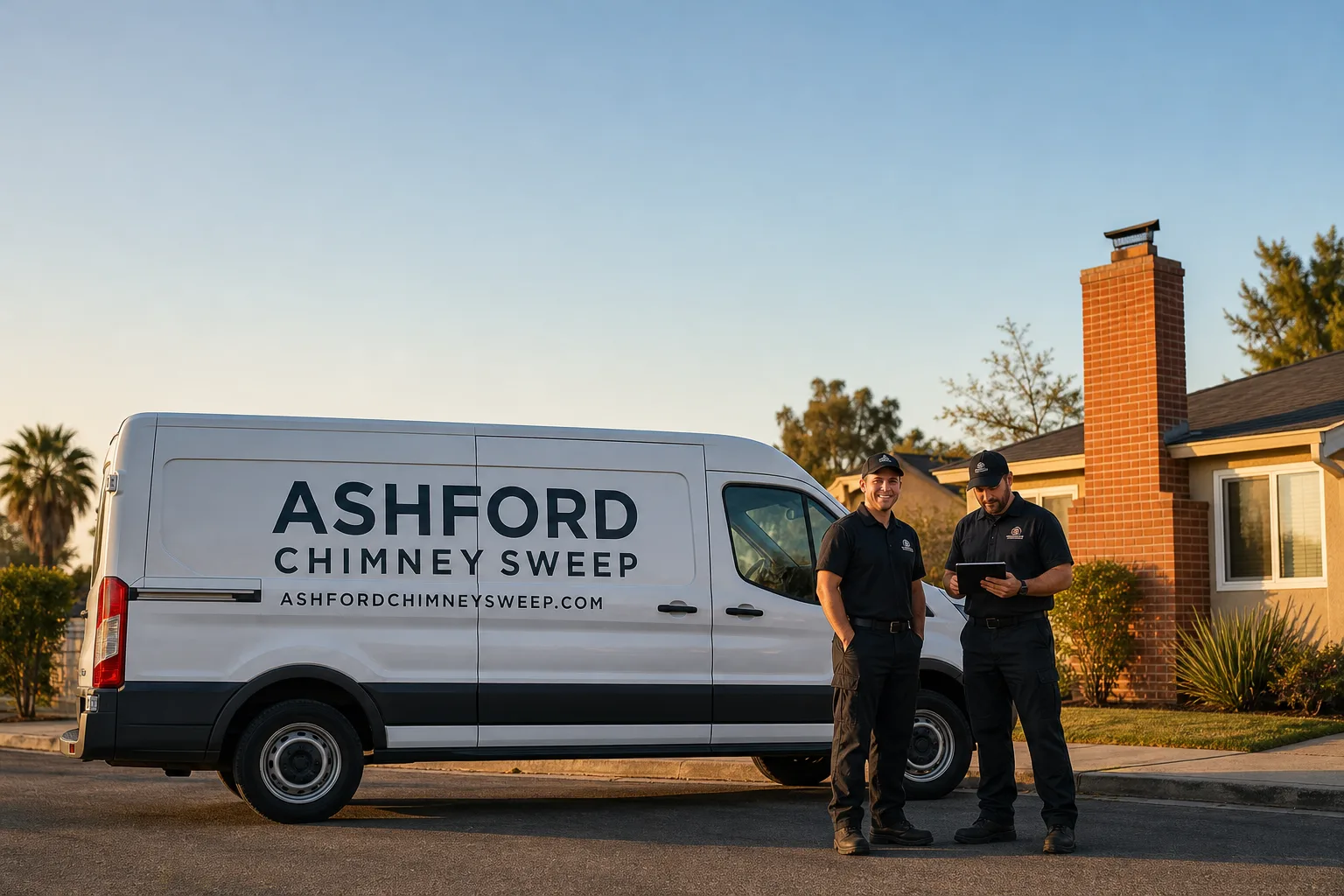
Fast, Reliable Dryer Vent Cleaning Across NoHo Arts District
Dryer vent cleaning in NoHo Arts District typically runs $130 to $240 for a standard single-story home with a wall termination, and $180 to $320 when the duct runs through the attic to a rooftop hood. Most jobs take under an hour once our tech arrives on site. If you live in the bungalow courts, the theater-district apartments, or any of the narrow-lot infill homes throughout the 91601 core, this is the page that explains why your vent clogs the way it does and what we do about it. Call (833) 589-9860 for a free estimate. We answer 24/7 and dispatch from 7am to 7pm, Sunday through Friday.
We work throughout NoHo Arts District every week. Our crews know the housing stock here: early-20th-century craftsman bungalows, Spanish Colonial Revival cottages, small stucco apartment buildings, and the newer narrow-lot infill that packs a full laundry system into a central closet with no exterior wall in sight. That last one matters more than most people realize, and we’ll get into it below.
Key Takeaways
- Dryer vent cleaning in NoHo Arts District costs about $130 to $320 depending on duct length, roof access, and how clogged the run is.
- Narrow-lot infill homes here routinely have 25-foot-plus attic-to-roof duct runs with multiple elbows, which collect lint fast.
- Builder-grade flex duct is often crushed or kinked at handover, choking airflow from day one.
- A vent that was never cleaned doesn’t just slow drying. It’s a documented fire risk.
- Estimates are free and the written quote is the price. Call (833) 589-9860.
Why NoHo Arts District Homeowners Call Ashford Chimney Sweep for Dryer Vent Cleaning
We’re a full-service venting specialist, not a general handyman who runs a brush through a duct and calls it done. Our dryer vent cleaning work is treated the same way we treat every fire-safety service we offer: with the right tools, a camera check when the run warrants it, and a written report of what we found. In NoHo Arts District, that distinction matters because so many duct runs are hidden in attics where you can’t see the problem yourself.
Owner Dennis Duran has built Ashford Chimney Sweep around one consistent rule: we repair what we find. When we clean a dryer vent and spot crushed flex, a bird nest, or a sagging low spot in the attic run, we tell you and we fix it. No handoff to another contractor. That’s why homeowners here keep calling us when a vent has been ignored for years.
We know NoHo Arts District’s streets, its alleys, its parking quirks, and its roofs. We’ve pulled lint out of rooftop hoods on Lankershim-adjacent apartment buildings and out of wall terminations on bungalow courts where the laundry sits against an original exterior wall. The neighborhood’s mix of old and new housing gives us two very different vent profiles to diagnose, and we know both.
Why Your New NoHo Arts District Home Might Already Need a Vent Cleaning
Here’s the thing most people don’t know about this neighborhood, and it’s the reason a house built five or even three years ago can already be a fire hazard. NoHo Arts District’s infill is mostly narrow-lot homes and small apartment buildings where the laundry sits in a central closet or hallway with no exterior wall nearby. Builder crews ran the dryer duct up through the attic and out the roof rather than straight through a side wall. Runs of 25 feet or more with multiple elbows are routine here, not the exception they are in the Valley’s wider-lot subdivisions.
Long duct runs collect lint at every bend. Every elbow is a friction point where airflow slows and lint drops out of the air stream. A straight 8-foot wall vent needs cleaning maybe every two or three years under normal use. A 25-foot attic run with three elbows traps the same lint load in half that time. And because the dryer still heats and tumbles, you don’t notice anything wrong until a load needs two full cycles.
There’s a second problem specific to new construction here: builder-grade flex duct is often stretched tight across attic framing at handover and crushed into elbows. We’ve pulled flex duct out of NoHo Arts District attics that was never round in its life. It left the supplier round. By the time the drywall crew finished, it was oval, kinked, sagging, and doing almost nothing for airflow.
Our Dryer Vent Cleaning Services in NoHo Arts District
We clean the whole vent system, not just the lint screen. Here’s what that means when we arrive at a NoHo Arts District home.
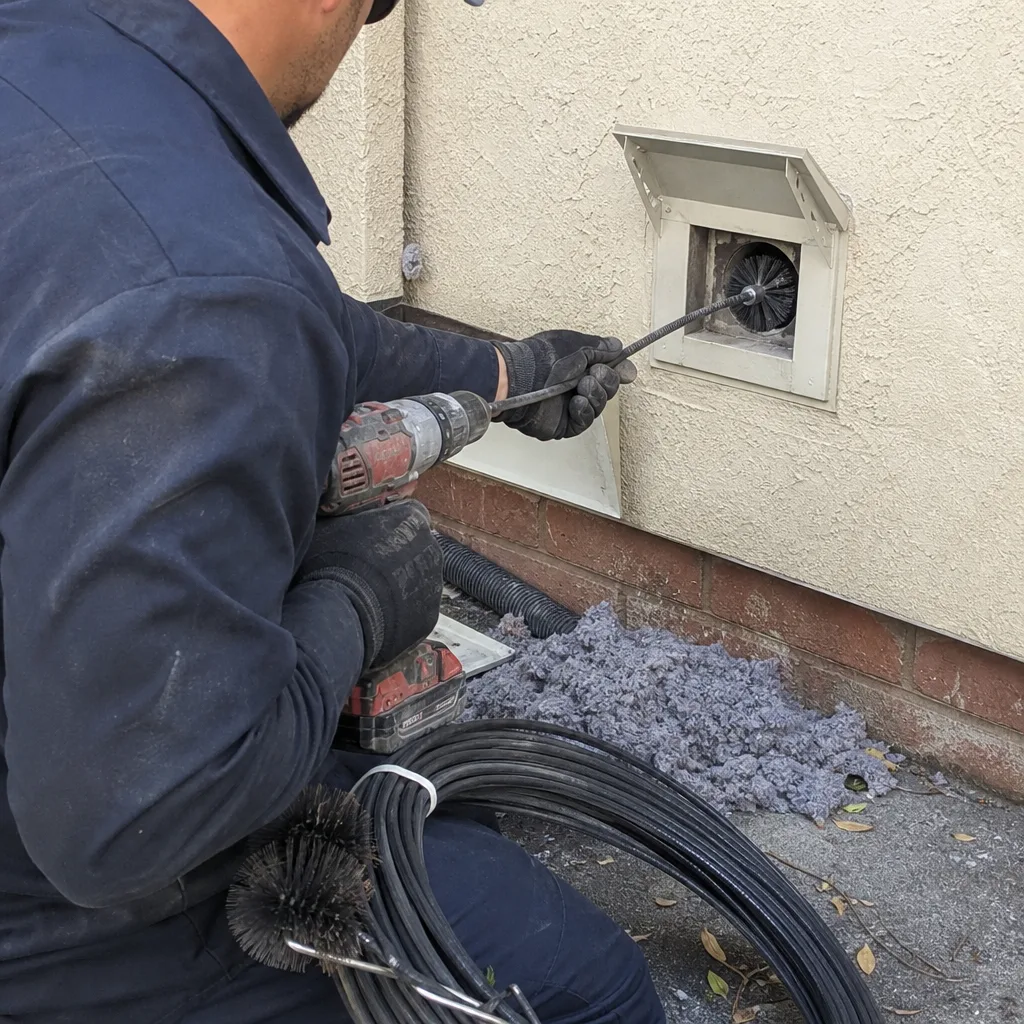
Full Vent System Cleaning
We run a rotary brush and high-airflow vacuum through the entire duct run, from the dryer connection behind the appliance to the exterior hood or rooftop termination. For the long attic runs common in NoHo Arts District’s central-laundry homes, this is not a five-minute poke with a shop vac. The brush has to reach every elbow and the full slope of the run. We also check the run while we work and note any crushed, sagging, or disconnected sections for repair.
Lint Screen and Trap Cleaning
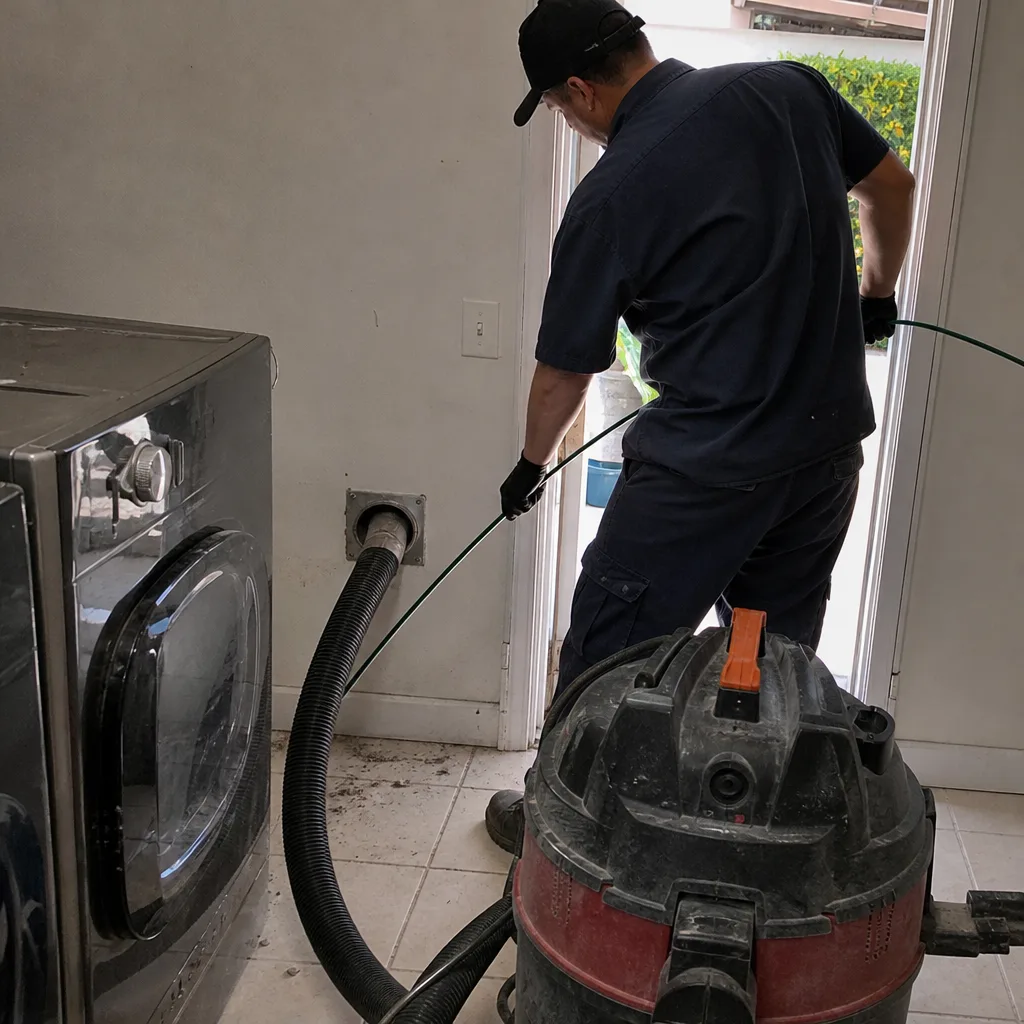
Your lint screen catches maybe a quarter of what your dryer sheds. The rest moves into the duct. We clean the trap housing and the screen itself, and we check the area behind and below the lint trap where lint often packs in around the blower housing. In NoHo Arts District’s older bungalows, this area is frequently caked with years of compressed lint the homeowner assumed the screen was handling.
Rooftop Vent Cleaning
This is the service that matters most for the neighborhood’s newer builds. Rooftop dryer vent terminations clog with lint, bird debris, and dust that settles from above, and unlike a wall vent, there’s no flapper at eye level to check. The failure is silent. We access the roof, remove the hood or cap, clean the termination thoroughly, and verify the flap opens under normal dryer airflow before we come down. If the run needs repair, we do that while we’re up there.
Full Vent System Inspection
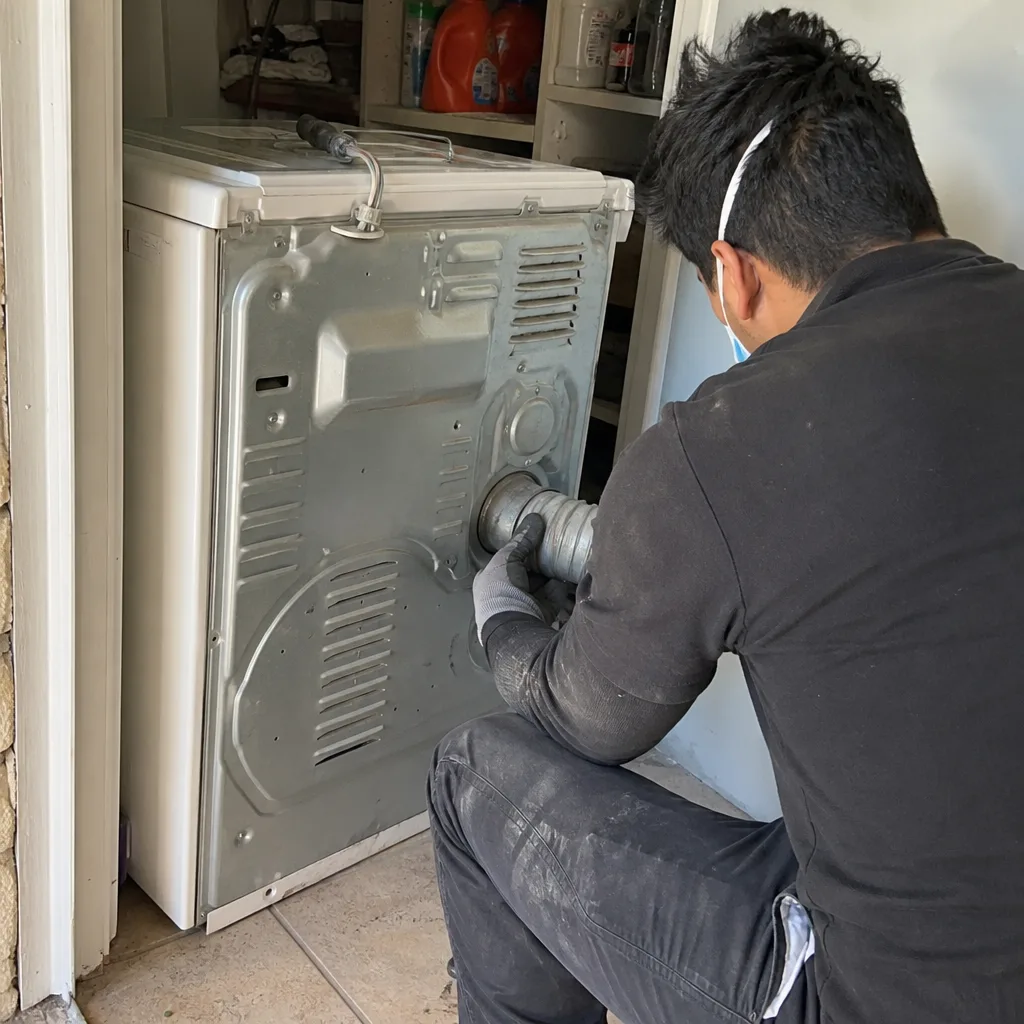
Every cleaning includes an airflow check and a visual inspection of the accessible duct run. For long attic runs, we’ll put a camera in the duct if we suspect blockage or damage that our brush can’t resolve. You’ll see exactly what we see. No upselling on “maybe problems.” If it’s dirty, you see the before and after. If it’s damaged, we show you and quote the fix.
Common Dryer Vent Cleaning Problems We See in NoHo Arts District Homes
- Builder flex duct crushed at handover. On a recent build on a tight lot near the 91601 core, a new homeowner called because a single load of towels took two full cycles to dry. Our tech found the builder’s flex duct pulled taut and crushed into two 90-degree elbows in the attic, caked solid with construction lint and drywall dust never cleared after handover. We replaced the crushed section with smooth rigid duct, cleaned the full run and the rooftop hood, and the dryer’s cycle time dropped back to normal on the first load we tested.
- Rooftop terminations clogged from above. NoHo Arts District’s newer homes vent through the roof, and the hood up there collects everything: lint, dust, bird debris, and whatever the wind drops in. There’s no wall flapper to inspect, so the clog grows undisturbed. By the time drying slows, the run is often 70 percent blocked or worse.
- Central-laundry long runs with too many elbows. A dryer duct should be as short and straight as possible. In this neighborhood’s narrow-lot homes and small apartment buildings, it usually isn’t. Every elbow in a 30-foot run is another lint trap. The appliance still heats, so you don’t notice. The duct is slowly becoming a chimney full of fuel.
- Decades of lint in original bungalow wall vents. The 1910s-to-1940s craftsman and Spanish Colonial bungalows here often have short wall vent runs, which is good. What’s bad is that many of them have never been cleaned. Short doesn’t mean self-cleaning. We’ve brushed out solid cores of packed lint from wall runs that had maybe 20 percent of their original airflow left.
Where Lint Actually Collects in a House With a Central Laundry Closet
If your NoHo Arts District laundry sits in a hallway closet or a stacked unit in a central nook, the duct goes up before it goes out. That changes everything about how lint behaves. In a straight wall run, lint mostly clears the duct under normal airflow and only a fine film builds over time. In a vertical run with turns, gravity and turbulence work together. Lint drops out at every elbow, in every low spot where the duct sags, and at the roof penetration where the run turns horizontal to exit through the hood.
None of that is visible from the laundry closet. You can’t see the sagging flex in your attic. You can’t see the growing blanket of lint at the second elbow. You only see the symptom: laundry takes longer, the dryer feels hot on top, and the laundry closet gets humid while the machine runs.
How We Clean a Rooftop Dryer Vent on a High or Steep Roof
We access every rooftop termination in NoHo Arts District with the same safety standards we apply to every elevated work site. Our tech is trained and equipped for roof access on the single-story bungalows and two-to-three-story apartment buildings common here. We use roof ladders and safety harnesses where the pitch or height requires them.
Once at the termination, we remove the hood or cap, run our cleaning tools down the full duct run from the roof side, and vacuum the debris out. On tall or steep roofs where the run is long, we may clean from both ends: the roof and the dryer connection inside the laundry closet. After cleaning, we verify airflow at the hood and test that the flap opens when the dryer runs. We photograph the finished termination so you can see the work without climbing up yourself.
If a roof is unsafe to access without risking damage to the roof surface or the tech, we’ll say so plainly and discuss alternative access. We don’t gamble with your roof or our people.
How Often Should a Dryer Vent Be Cleaned in NoHo Arts District?
For a straight wall vent in a single-story bungalow with one or two adults, every two years is usually enough. For a central-laundry home with a long attic-to-roof run, we recommend an annual check. For a small apartment building with shared laundry or multiple units venting through a common chase, every year, sometimes more often if the usage is heavy.
The hot, dry San Fernando Valley climate doesn’t make your vent dirtier by itself, but it does make the lint inside it drier. Lint that sits for years in a dry attic run is more easily ignited by a single spark or an overheated duct. That’s the fire-safety reason we don’t treat dryer vent cleaning as a courtesy add-on. It’s the same rigor we apply to every venting service we perform.
If My Dryer Vent Goes Out the Roof, What Signs Tell Me It Needs Cleaning Before It Becomes a Hazard?
The clearest sign is drying time. A load that once dried in 45 minutes and now takes 90 is a blocked vent until proven otherwise. The dryer itself is usually fine: the thermostat cycles normally, the tumbler spins. The machine just can’t push hot humid air through a clogged duct, so it sits in the drum and the cycle runs long.
Other signs to watch:
- The dryer’s top or sides feel unusually hot during a cycle.
- The laundry closet gets warm and humid while the dryer runs.
- You smell a faint musty or burning odor when the dryer is on. That’s not normal operation.
- The exterior flap at the roof hood doesn’t open when the dryer is running, or it flaps weakly.
- There’s lint visible around the dryer connection or the lint trap housing after every load.
If you notice any of these in a NoHo Arts District home, call (833) 589-9860 before the next laundry day. We’ll give you a straight answer about whether the vent needs cleaning, and the estimate is free.
Pricing for Dryer Vent Cleaning in NoHo Arts District, CA
A standard Full Vent System Cleaning in NoHo Arts District runs $130 to $240 for a wall-vented home. When the duct runs through the attic to a rooftop hood, the job typically runs $180 to $320 because of the extra roof access and the longer run. Rooftop Vent Cleaning as a standalone service runs $90 to $160 when the roof is safely accessible without specialty equipment. Lint Screen and Trap Cleaning is included in every full cleaning; on its own it’s typically $45 to $75, usually as part of a larger visit.
These are estimated ranges for NoHo Arts District’s housing stock. What moves the final number: duct length, number of elbows, roof access difficulty, and how heavily clogged the run is. If we find crushed flex duct or a damaged section during the cleaning, we’ll quote the repair separately and show you exactly what we saw. Nothing gets recommended without evidence. The written estimate you approve before work begins is the price. Call (833) 589-9860 for a free estimate.
Serving NoHo Arts District, CA – Our Local Coverage Area
We serve NoHo Arts District and nearby communities. Use the map below to see the area we cover. If you’re nearby, we can almost certainly help.
FAQs – Dryer Vent Cleaning in NoHo Arts District
Yes, especially if your laundry is in a central closet and the duct runs through the attic to the roof. In NoHo Arts District’s narrow-lot infill homes, builder crews routinely left crushed flex duct and construction debris in the run at handover. A five-year-old run can already be significantly blocked. We’ll clean it and show you what came out, so you’ll know whether this was overdue or just due. Call (833) 589-9860 to schedule.
Because the vent, not the dryer, is almost always the bottleneck. A new dryer produces plenty of heat. If the duct can’t carry the humid air out, the moisture stays in the drum and the clothes stay damp. We see this constantly in NoHo Arts District’s newer builds, where the duct was installed incorrectly at handover and never corrected.
Lint collects at every elbow, in every sagging low spot, and at the roof penetration where the run turns horizontal to exit. In a central-laundry NoHo Arts District home with a 25-plus-foot attic run, the first big buildup is usually at the first elbow above the dryer, and the second at the roof hood itself. Both are invisible from inside the house.
We use roof ladders and safety harnesses where the pitch or height requires them. We remove the hood or cap, clean the run from the roof side, vacuum out the debris, and verify the flap opens under airflow before we come down. If your NoHo Arts District roof is too steep or fragile for safe access, we’ll tell you plainly and talk through the alternatives.
Drying times that stretch to two cycles, a hot dryer cabinet, a warm humid laundry closet, a weak or motionless flap at the rooftop hood, and any burning smell while the dryer runs are the main warning signs. Any one of them is enough reason to have the vent inspected. Call (833) 589-9860 and we’ll get a tech to your NoHo Arts District home.
We Also Serve Cities Near NoHo Arts District
Ashford Chimney Sweep works throughout the NoHo Arts District and the surrounding communities, including North Hollywood, Toluca Lake, Valley Village, and Studio City. If you’re a few blocks outside the district line, you’re still in our regular service area. Call us and we’ll confirm the schedule for your address.
Call Ashford Chimney Sweep for Dryer Vent Cleaning in NoHo Arts District
If your dryer has been getting slower, or you’ve never seen the inside of your vent run, don’t wait for the first sign of trouble. We’ll clean the full system, check the duct, and show you proof the work was done. Call (833) 589-9860 for a free estimate. We answer 24/7. Fast dispatch from 7am to 7pm, Sunday through Friday.
Written by Dennis Duran, Owner at Ashford Chimney Sweep, serving NoHo Arts District since 2012.